

“There’s something within the human mind that is attracted to straight lines and not curves…and to certainties and not mystery. A part of us that has emerged recently has designed buildings as boxes with uncompromising straight lines and surfaces. Another part of us recognizes that nature designs in fractals with intriguing detail from the microscopic to the macroscopic. That part of us makes Gothic cathedrals and Persian carpets, symphonies and novels, Mardi Gras costumes and artificial intelligence programs, all with embellishments almost as complex as the ones we find in the world around us.”
Donella Meadows (1941-2001)
Donella H. Meadows was a chemist and science writer, and lead author of The Limits to Growth (1972), which sparked a debate around the world about the Earth’s carrying capacity and human choices. As a researcher/lecturer at MIT, she translated complex system-dynamics into accessible analysis. As a leading innovator in the field, she founded the Sustainability Institute in 1996 (now The Academy of Systems Change) to apply systems thinking to economic, environmental and social challenges. Her book, Thinking in Systems, was published posthumously in 2008 and became an international bestseller.
Systems Thinking
- The idea that what happens to an individual in their life is the result of how our society is organized. (Characters are inside systems not outside of them.)
- The inter-connectedness of systems impacted by climate, are eco-systems on local and increasingly global levels. (Feedback loops of consequence and interdependence: ice melt, heat, inequality, migration, immigration.)
- Leverage Points—places of power in a system where a small change could lead to a large shift in behavior. These are frequently not intuitive. (How do stories locate responsibility? How do characters imagine catalytic roles?)
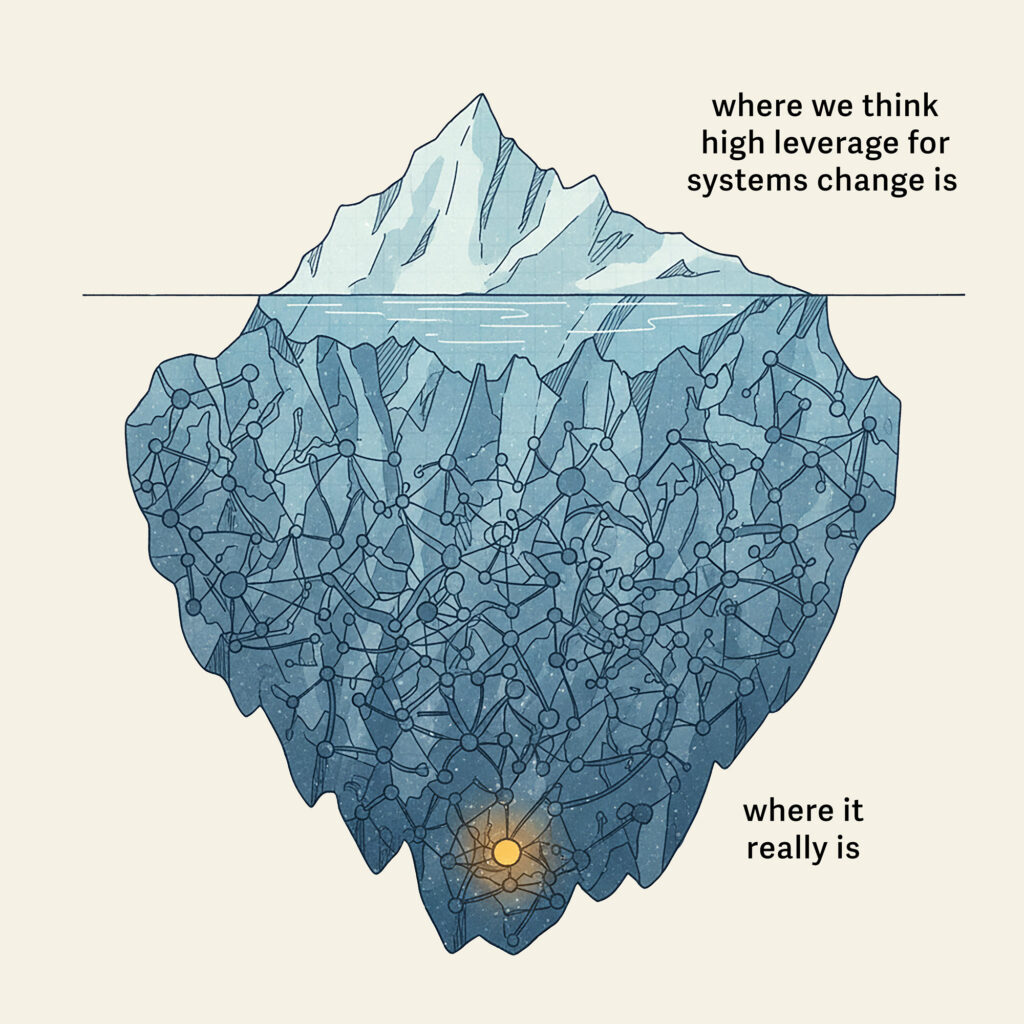
The mindset that “the system is rigged” is prevalent, according to research by FrameWorks Institute. But the disconnect between knowing the scope of problems and not knowing what can fix them creates a dangerous willingness to hand power over to an outside actor who can come in and change everything. Research has proven that stories situating individual choices within their larger structural context can foster empathy, shift attitudes about who is responsible for solving societal problems, and build policy support. The climax or arc is often a reconfiguration: a regulation change, a value shift, a new feedback loop, a reveal of information leading to a paradigm shift. Systems thinking can rack focus from invisible to legible.
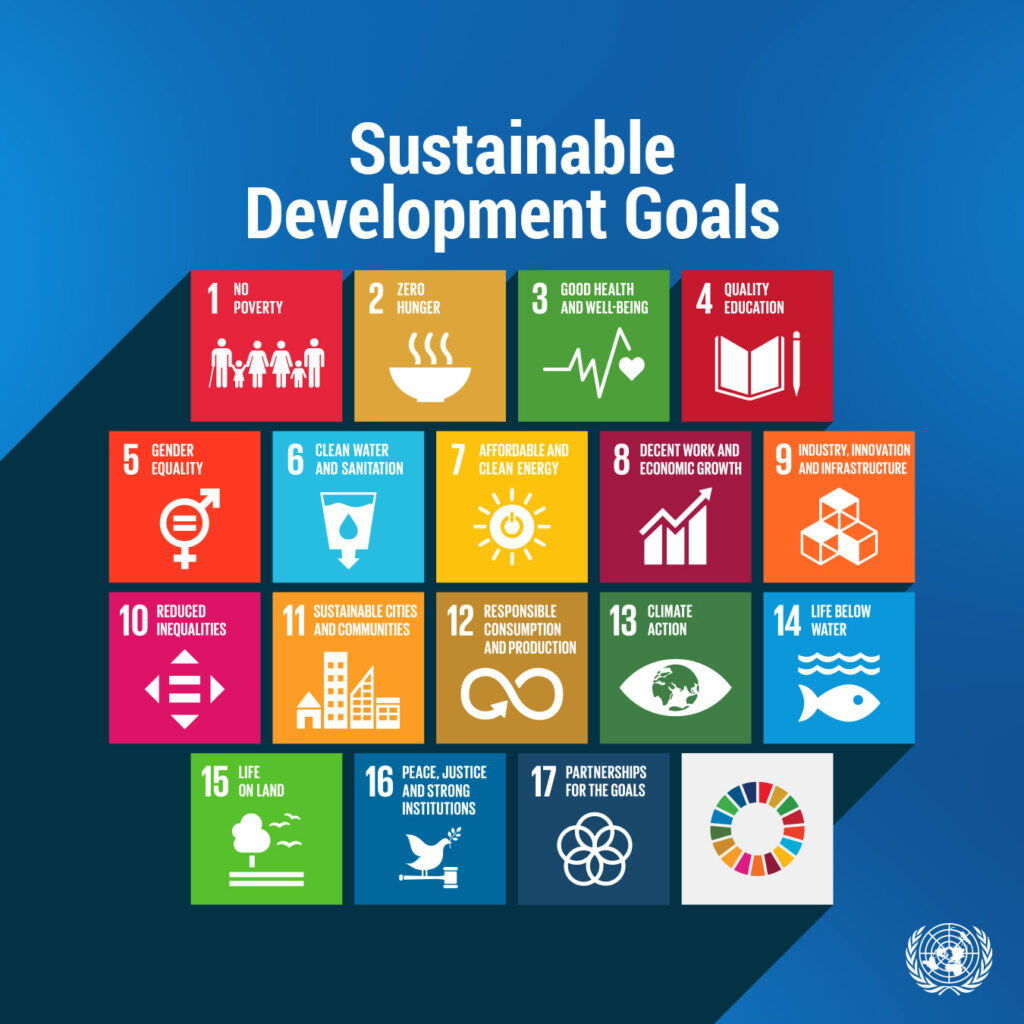
The UN’s 17 Sustainable Development Goals
The UN’s 17 Sustainable Development Goals are interconnected human-Earth systems embraced as conditions for people to survive and thrive. Creatives can explore the ways climate interacts with these goals to deepen complexity and systemic relevance in storytelling.
How many of the UN SDGs intersect with your story?
Appealing to shared values in our storytelling (care, fairness, responsibility, belonging, stewardship) will translate these systems into human meaning for audiences. With the power to transform paradigms of storytelling, systems thinking doesn’t tell us what to think, it changes how we think.
Identify the Systems in Which Your Story Resides
- Narratives are temporal structures. When does your story exist? How does it relate to the future?
- What world feels inevitable? What world feels possible? What world feels desired? Consider moral complexity and the possibility of futures left open.
- For climate change, a slow, systemic issue—where would your narrative interrupt normalization? How do we let go of certainty? How do we relate to change?
- What leverage level does your story live within? What is the mindset out of which the system arises? Where are the parameters? Is climate harm accidental or authorized?
- Who knows what, and when? Where does credibility reside?
- How do we perceive risk, gauge time and irreversibility?
- How do we connect present choices to future lives and respect intergenerational responsibility as an ethos? Can we expand our ethical imagination?
“Systems are very strong, and stories are like throwing rocks at a wall. But we have to remember that systems are fossilized stories. They are the codified stories of our past. The stories we told ourselves about endless growth markets…all these things that have broken down and are no longer serving us. We have to build the stories that will one day become the systems of our future.”
Daniel Kwan, co-director/writer, Everything, Everywhere All At Once, at the 2023 Hollywood Climate Summit